

Amidst the accelerated digital transformation in Latin America, Colombian companies are increasingly demanding higher standards for office security and attendance management. Traditional access cards are easily borrowed or copied, fingerprint attendance poses hygiene risks due to contact and is sensitive to finger condition, while facial recognition is affected by factors such as lighting and masks—especially in high-end office buildings, technology parks, and multinational corporate headquarters. Managers urgently need a contactless, high-precision, and anti-cheating integrated access and attendance solution. Addressing this market demand, HFSecurity successfully deployed a palm vein recognition gate access control and attendance system for a Colombian corporate headquarters building. Deeply integrating palm vein recognition devices with access gates, employees can complete identity verification, access authorization, and attendance recording simply by raising their hand—a completely contactless and media-free process. Furthermore, HFSecurity provides a free SDK and complete API interfaces, supporting customers' independent development and integration into their own management systems, setting a new benchmark for smart access control management in Latin American corporate office scenarios.
The company's headquarters building, located in a major Colombian city, houses multiple floors of office space and hundreds of employees, receiving a large number of visitors and partners daily. The previously used IC card access control and independent attendance system had long suffered from multiple pain points: frequent instances of employees forgetting or losing their cards, resulting in high administrative costs for card replacements; difficulty in tracing card borrowing or misuse, making it impossible for security personnel to verify the identity of those using the access cards; and the disconnect between attendance data and access control records, requiring HR to spend significant time manually verifying them monthly, which was inefficient and prone to errors. With the company's expansion and digital transformation, management urgently needed an integrated smart access control solution that could prevent proxy clocking and tailgating while enabling attendance tracking upon entry.
HFSecurity's palm vein recognition device uses near-infrared light to read the distribution of subcutaneous veins in the palm for identity authentication. Palm veins are an internal physiological feature of the human body, hidden beneath the skin of the palm, making them extremely difficult to replicate or forge, and requiring a living person to be read by the device—photos, screen captures, and prosthetic models all fail to pass verification. This technology employs a dual-factor authentication mechanism combining palmprint and palm vein recognition. A wide-angle optical camera identifies the epidermal features of the palmprint, while an infrared camera identifies the subcutaneous vascular distribution characteristics of the palm veins. Verification is only complete when both factors are matched simultaneously.
Compared to fingerprint recognition, palm vein recognition does not require contact with the device surface, eliminating the risk of fingerprint duplication or "theft," and is unaffected by conditions such as peeling skin, moisture, or oil on the fingers. Compared to facial recognition, palm vein recognition is unaffected by changes in lighting, wearing masks, or facial angles. Compared to IC cards, palm vein recognition completely eliminates the problems of forgetting to bring the card, losing it, or having it misused. Palm vein recognition is widely recognized as one of the most secure biometric technologies currently available.
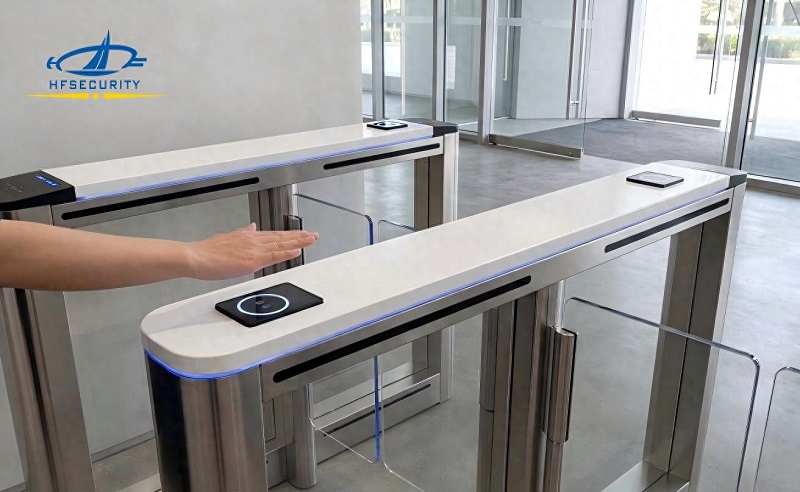
HFSecurity deeply integrates palm vein recognition devices with turnstiles (tripod turnstiles, swing gates, wing gates), providing a complete integrated solution from the recognition terminal to the turnstile body. After employees raise their hands to complete palm vein recognition at the turnstile, the turnstile automatically opens, and the system simultaneously records the entry time and personnel information—a single action completes access authorization and attendance registration, completely eliminating management blind spots such as "not swiping after passing through the turnstile" or "forgetting to pass through after swiping." The physical structure of the tripod turnstile and swing gate effectively prevents tailgating and climbing over, allowing only one person to pass at a time, significantly improving the security level of entrances and exits.
For companies with multi-story, multi-area offices, the system supports granular access control. Employees from different departments can enter designated floors or areas based on authorization, while unauthorized personnel cannot enter sensitive areas such as the finance office, server room, and executive offices. The device supports offline operation mode; even when the network is interrupted, it can still recognize and store access records locally, and automatically synchronize to the backend after the network is restored, ensuring no data loss.
HFSecurity provided a free SDK development package and complete API interface documentation for this collaboration, which is one of the core advantages of this solution compared to traditional closed access control systems. The client's IT team can complete the following independent development tasks without relying on the vendor:
Seamless System Integration: Quickly integrate the verification results, user IDs, and access records of the palm vein recognition device into the enterprise's own OA, HR, or security management platform, achieving unified identity authentication and data flow.
Automatic Attendance Data Push: Every access record is automatically synchronized to the enterprise's HR system, and attendance reports are generated in real time, eliminating the need for HR to manually import data.
Unified Access Control: When employees join, leave, or change positions, administrators can synchronize access control permissions with a single click within their own system, without needing to log into multiple management backends.
Customized Business Processes: Clients can customize data flow, user interface, and business logic according to their own management needs, truly maintaining control of the system.
This open architecture provides ample room for future functional expansion (such as visitor management, meeting room reservation linkage, etc.), fully protecting the client's long-term investment.
HFSecurity has over 20 years of experience in the R&D and manufacturing of biometric devices, providing Colombian enterprises and system integrators with end-to-end customized services from hardware to software. On the hardware side, the gate's body color, brand logo silkscreen, and recognition module position can all be adjusted as needed; on the software side, the attendance terminal's boot interface, system language (supporting Spanish), menu structure, and functional flow can all be flexibly configured according to the company's actual management requirements.
Colombia, as the third largest digital economy in Latin America, is accelerating its digital transformation. HFSecurity's palm vein attendance and access control solution, with its core advantages of liveness detection, unforgeability, and open integration, is helping Latin American companies overcome the inconveniences of traditional access cards and fingerprint attendance, providing a more efficient, secure, and intelligent access control experience for workplaces. In the future, HFSecurity will continue to deepen its presence in the Latin American market, helping more companies achieve a comprehensive upgrade to smart office solutions with more reliable hardware quality and more open customization capabilities.