

In dining environments such as restaurants and canteens, issues like checkout queues, forgotten wallets, dead phone batteries, and lost membership cards have long plagued both consumers and operators. Traditional payment methods not only detract from the dining experience but also hinder table turnover and operational efficiency. To address these challenges, HFSecurity has launched a handheld palm vein POS terminal that deeply integrates palm vein biometrics with mobile payment technology. Customers can complete identity verification and payment simply by raising their hand—a process that is entirely contactless and requires no physical tokens—offering a new payment solution that combines high security with high efficiency.
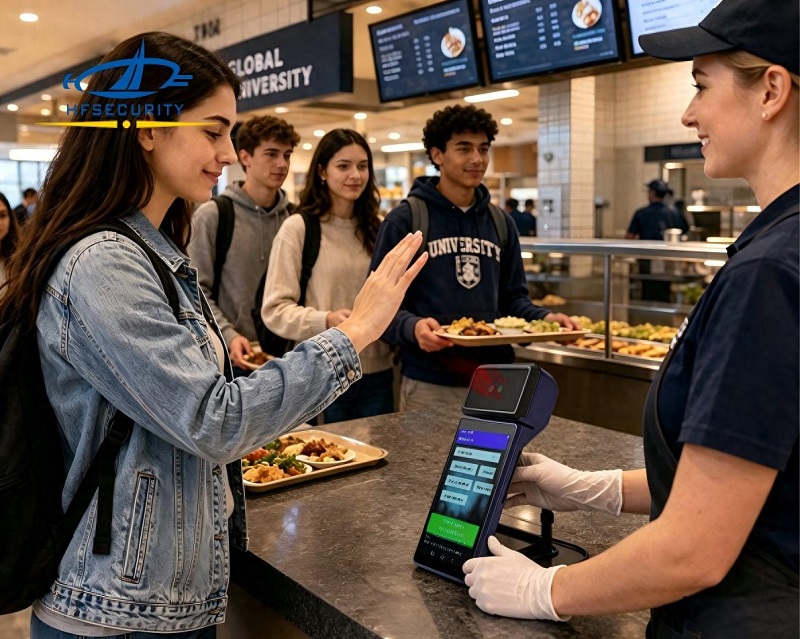
In venues like restaurants and canteens, payment efficiency directly impacts the customer experience and the establishment's table turnover rate. QR code payments rely on phone battery levels and network signals; during peak hours, network congestion often leads to payment failures or delays. Membership card payments face issues such as cards being forgotten, lost, or fraudulently used, while cash transactions involve cumbersome change-making and hygiene concerns. Meanwhile, membership management and marketing present their own difficulties: customer membership data is often disconnected from the payment process, making it impossible to achieve a seamless experience where payment and identification happen simultaneously. Dining operators urgently need a payment method that is contactless, highly secure, and independent of physical media, network connectivity, or battery life.
The HFSecurity handheld palm vein POS terminal uses near-infrared light technology to read the distribution of subcutaneous veins in the palm for identity verification. Palm veins are internal physiological characteristics located beneath the skin; they are extremely difficult to replicate or forge and require a living subject to be detected—meaning methods such as photos, screen captures, or prosthetic models cannot pass verification. The technology employs a dual-factor verification mechanism combining palm prints and palm veins: a wide-angle optical camera identifies surface palm print features, while an infrared camera identifies subcutaneous vein patterns. Verification is only completed when both factors match.
Unlike membership cards, palm vein payment eliminates the need to carry physical media, completely resolving issues like forgetting or losing cards. Unlike QR code payments, it does not rely on mobile battery life or network signals. Compared to facial recognition, palm vein technology is unaffected by lighting changes or the wearing of masks. Palm vein patterns remain constant throughout a person's life—unaffected by age, skin tone, or skin elasticity—offering higher accuracy and security than traditional identification methods. Customers can pay simply by raising their hand, making it ideal for situations where retrieving a phone or wallet is inconvenient, such as when carrying a food tray or holding items.
The HFSecurity handheld palm vein POS terminal features a lightweight, all-in-one design with a high-capacity battery and a high-performance recognition module, supporting extended mobile use. The device can be flexibly deployed across various dining scenarios:
Cafeteria Service Windows: Customers complete identity verification and payment by raising their hand at the POS terminal. The entire process takes just 1–2 seconds, significantly reducing queue times during peak hours and effectively increasing turnover rates.
Restaurant Checkout Counters: The handheld POS supports both stationary and mobile payment modes, allowing for flexible deployment during peak hours to manage customer flow.
Private Dining Rooms and Banquets: Staff can carry the device to process payments directly within private rooms, eliminating the need for customers to queue at the front desk and enhancing the premium dining experience.
Food Courts and Group Meal Delivery: Supporting mobile payments, the POS terminal enables identity verification and transaction processing anywhere, flexibly adapting to complex environments with multiple stalls and vendors.
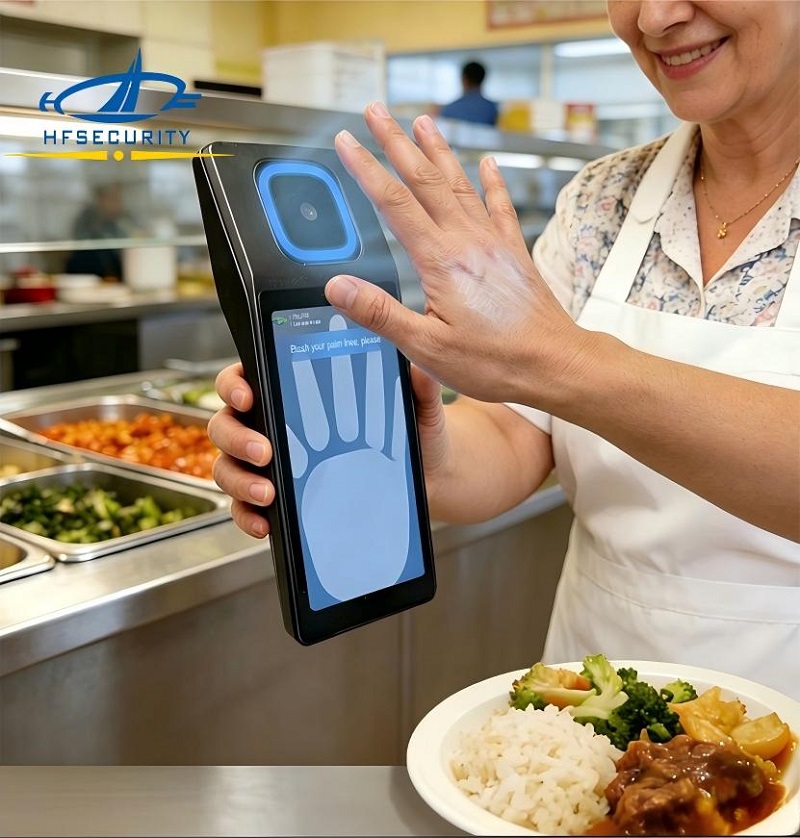
The device supports offline operation; it continues to perform recognition and store data locally during network fluctuations or outages, automatically synchronizing with the backend system once connectivity is restored to ensure uninterrupted service.
The HFSecurity handheld palm vein POS terminal serves not only as a payment tool but also as a gateway for membership management. Upon first use, customers simply raise their hand for a few seconds to capture their palm vein pattern and link it to their mobile number or membership account. For all subsequent transactions, payment is completed with a simple wave of the hand; the system automatically identifies the member, accumulates points, and redeems coupons without requiring any additional action. The store's backend system records each member's consumption frequency, average transaction value, and dish preferences in real-time, providing data support for precision marketing, menu optimization, and inventory management. Restaurant operators can analyze customer taste preferences based on consumption data to implement personalized marketing tailored to individual customers, thereby boosting repeat business and loyalty. Palm vein recognition technology eliminates issues like proxy scanning or identity theft at the source, effectively solving management challenges associated with borrowed or stolen membership cards.
Competitiveness in the food and beverage industry is defined not only by food and service quality but also by the payment experience, which significantly impacts overall customer satisfaction. HFSecurity’s handheld palm vein POS terminal enables a seamless "pay-by-wave" experience, helping restaurants achieve:
Enhanced checkout efficiency: Transaction times are reduced to just 1–2 seconds, significantly easing queue congestion during peak hours.
Contactless hygiene: Eliminates the need for cash handling or physical contact with devices, reducing the risk of cross-contamination.
Automated member recognition: Recognition occurs simultaneously with payment, and loyalty points accumulate automatically without requiring extra steps from the customer.
Flexible payment options: Supports multiple methods—including palm vein recognition, facial recognition, and QR codes—to accommodate diverse consumer habits.
With over 20 years of experience in R&D and manufacturing biometric devices, HFSecurity offers end-to-end customization services—spanning both hardware and software—to restaurant operators and system integrators. Device aesthetics (color and branding), user interface languages, and functional menus can all be flexibly configured to meet specific client needs. Additionally, the company provides free SDKs and comprehensive API documentation, enabling rapid integration of the palm vein POS system into existing restaurant management systems, membership platforms, and financial software for unified data management and operational synergy.
From cash to QR codes, and now to palm scanning, restaurant payment methods are undergoing an upgrade toward "contactless, highly secure, and medium-free" solutions. Featuring core capabilities such as liveness detection, unforgeability, and immunity to external interference, HFSecurity’s handheld palm vein POS terminal helps restaurants eliminate problems like membership card misuse, dead phone batteries, and long queues. Moving forward, HFSecurity will continue to deepen its presence in the F&B sector, leveraging reliable hardware quality and open customization capabilities to establish "pay-by-wave" as the new global standard for restaurant payments.