

Recently, HFSecurity's independently developed core technological achievement—"A Biometric Recognition Method and System Based on Palmprint and Palm Vein Information Fusion"—was officially authorized by the State Intellectual Property Office, and the invention patent certificate was successfully issued.
The successful approval of this patent not only marks a key technological breakthrough for HFSecurity in the fields of multimodal biometric core algorithms and multi-source information fusion applications, but also further solidifies the company's core technological barriers in the palm vein biometric recognition field, once again demonstrating the brand's strong capabilities in independent innovation and hardcore R&D to the industry.
With the iterative upgrades of digital security and intelligent verification scenarios, the limitations of traditional fingerprint and facial recognition technologies are gradually becoming apparent in practical applications:
Fingerprint recognition is easily affected by skin abrasion, dryness, and dirt, and there is a security risk of fingerprint film forgery;
Facial recognition is easily affected by light intensity, makeup, glasses, and masks, and is accompanied by increasingly serious public privacy leakage issues during the collection process.
In high-end scenarios such as finance, government affairs, confidential locations, and public safety, the market urgently needs a new generation of identification technology that is highly secure, highly accurate, resistant to interference, and also protects privacy.
Against this backdrop, palm vein recognition technology, with its core advantages of "liveness uniqueness, deep anti-counterfeiting, non-contact hygiene, and privacy compliance," has become an inevitable direction for the evolution of next-generation biometric technology.
Palm veins are "invisible" biometric features deep under the skin, relying on the absorption of near-infrared light by hemoglobin in the flowing blood under the skin for imaging. This "unidentifiable without a living body" characteristic fundamentally eliminates the possibility of forgery through photos, videos, silicone molds, or even severed palms.
Palm print features, on the other hand, have the advantages of rich texture information and obvious surface features. HFSecurity's newly approved patent technology innovatively achieves bidirectional information fusion of "palm print surface features" and "palm vein deep liveness features":

Dual-feature multi-dimensional verification: The system simultaneously captures epidermal palm print clues and subcutaneous vein patterns in a very short time.
Intelligent Algorithm for Precise Matching: Through multimodal fusion algorithms and cross-comparison, the accuracy and stability of recognition are significantly improved, while the false acceptance rate (FAR) and false rejection rate (FRR) are reduced to extremely low levels in the industry.
Exceptional User Experience: Perfectly balancing financial-grade high security and millisecond-level ultra-fast recognition response, its technical indicators far exceed traditional single-identification solutions, reaching international advanced levels.
With years of experience in the biometrics field, HFSecurity has consistently focused on the R&D and industrialization of core palm vein recognition technologies. Relying on a complete technology chain of "independent algorithms + intelligent hardware + scenario systems," the company has customized highly competitive full-stack palm vein recognition scenario solutions to address pain points in various industries:
In large enterprise parks and office buildings, daily commutes face high-frequency and dense traffic pressure.
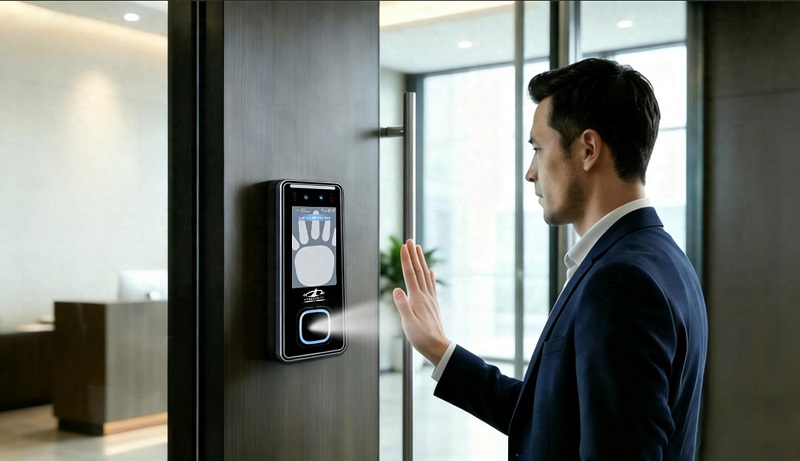
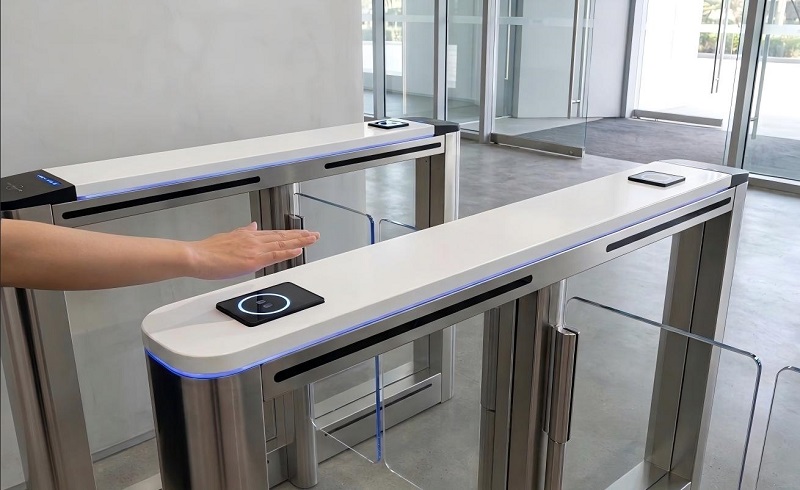
HFSecurity's palm vein access control/turnstile solution supports contactless, rapid hand-waving access, avoiding the hygiene risks and queuing congestion associated with traditional fingerprint attendance systems. Furthermore, palm vein recognition only collects data when the hand is clenched or waved, avoiding facial data collection, perfectly alleviating employee concerns about privacy leaks and complying with national privacy protection standards.
High-security areas such as bank vaults, cash depositories, and government data centers have near-zero tolerance for stringent identity verification requirements.
The solution employs dual encryption verification using palm print and palm vein patterns, combined with a liveness detection algorithm, completely blocking any impersonation methods. The system can be deeply integrated with physical access control, double-door interlocking, and AB door systems, providing dual protection through both human and technological safeguards, building an impenetrable "security firewall" for confidential spaces.

In scenarios such as school cafeterias, dormitories, and libraries, traditional campus cards are easily lost, and facial recognition accuracy fluctuates for adolescents who are still growing and developing.
HFSecurity's palm vein campus solution features algorithm optimizations tailored to the developmental characteristics of teenagers' hands. Students can simply "wave" their hand to complete dormitory check-in, cafeteria purchases, and library borrowing. No cards are needed, and it's unaffected by dirt or wet hands after washing, providing a safer and more convenient modern smart campus experience.
In frontline environments such as construction sites and manufacturing workshops, workers' hands are often calloused, worn, dusty, and heavily soiled, making traditional fingerprint recognition almost ineffective.
Since palm vein imaging relies on subcutaneous blood flow, even with dirt, oil, or minor scratches on the hands, the HFSecurity palm vein recognition terminal can still achieve accurate recognition within seconds. Combined with a real-name management system, the solution effectively addresses management pain points such as difficulty in attendance tracking and fake shifts for construction workers.
On the hardware side, HFSecurity has iteratively developed multiple high-performance palm vein recognition terminals, building a multi-form product matrix:
Desktop and standing terminals: suitable for government service windows and financial counter verification.
Wall-mounted and access control equipment: Suitable for various offices, meeting rooms, and confidential access control systems.
Embedded turnstile modules: Seamlessly integrate with various turnstiles, supporting strong outdoor light and complex environments.
All hardware features a self-developed fusion algorithm, boasting fast recognition speed, strong anti-interference capabilities, and high system compatibility. The stability and durability of the equipment have been fully validated in multiple rounds of global market applications.
The official approval of this invention patent marks a significant milestone in HFSecurity's technological innovation journey.
In the future, HFSecurity will continue to uphold the concept of innovation-driven development, continuously increase investment in core technology research and development, constantly optimize the palmprint and palm vein fusion recognition algorithm, and broaden the boundaries of technology applications. We will empower the high-quality development of the global smart security and digital identity verification industry with more robust products and more comprehensive industry solutions, continuously leading the innovation trend of multimodal biometric technology.