

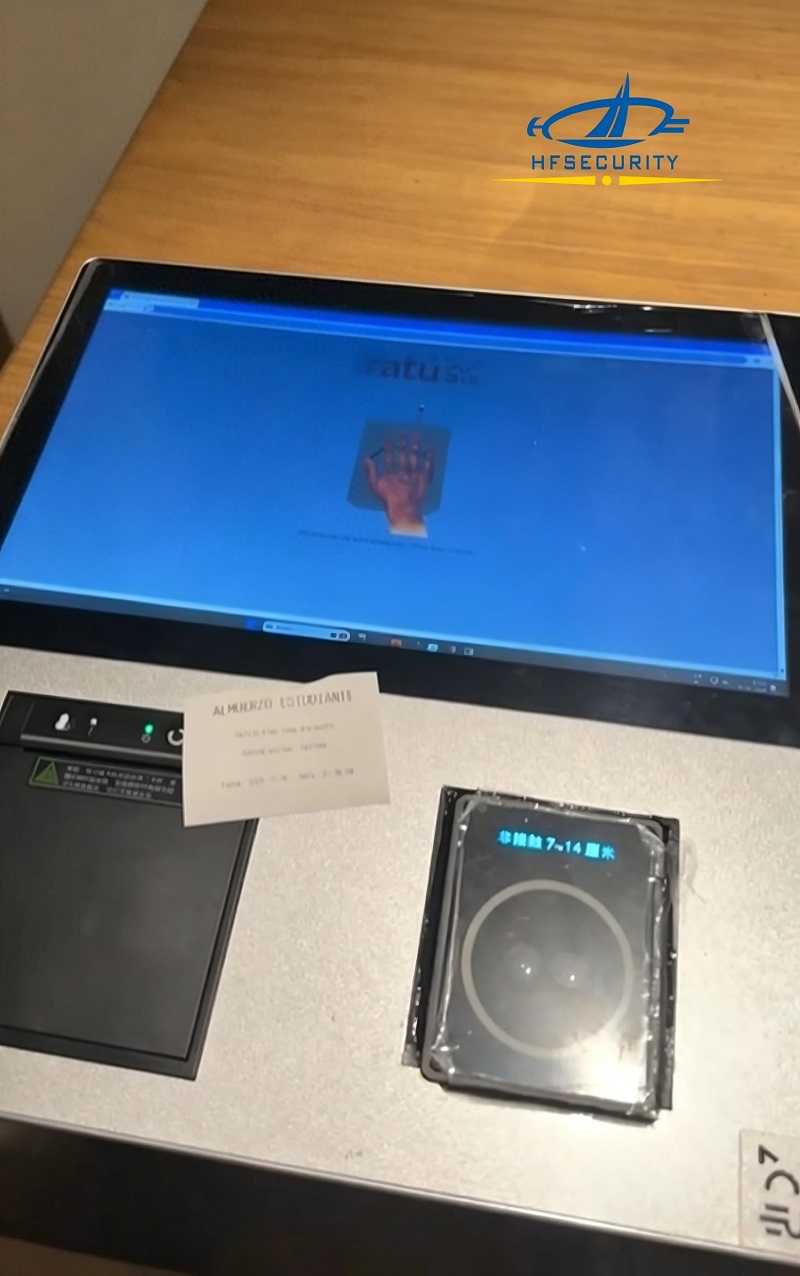
In Colombia, many schools are facing multiple challenges in campus payment management: time-consuming waiting times for students to recharge their meal cards, frequent replacement of lost physical cards, and health and safety risks associated with cash transactions in canteens and supermarkets. Even more tricky is that some students borrow other people's meal cards for consumption, which makes it difficult for parents to accurately grasp their children's school expenses and makes it difficult for schools to reconcile accounts. In response to these pain points, a private school in Colombia has recently completed a comprehensive upgrade of its payment system - based on HFSecurity palm vein recognition technology, the school has independently developed a biometric payment system integrated into the original campus management platform. Students can complete identity verification and deduction in canteens, supermarkets, bookstores, and other places by simply lifting their hands, without touching any devices or carrying cards or mobile phones.
Although traditional campus one card is popular, there are many drawbacks in practical use. The phenomenon of students losing or forgetting their cards is frequent, and reissuing cards not only incurs costs, but also consumes academic staff. More importantly, it is difficult to prevent the borrowing or theft of cards, and schools cannot confirm whether the consumption was made by the students themselves. Cash transactions involve tedious change and hygiene risks, and the process of counting and handing over money increases the risk of cross infection. The introduction of palm vein payment technology has fundamentally changed this situation - students only need to collect palm vein information in advance and bind it to their campus account. They can complete payments by lifting their hands during daily consumption without carrying any media, completely eliminating the problems of lost cards, forgotten cards, and fraudulent use, while greatly improving settlement efficiency.
The palm vein recognition technology provided by HFSecurity uses near-infrared light to read the distribution of subcutaneous veins in the palm, forming unique biometric features for each individual. Compared to fingerprints, students' palms do not affect recognition due to sweating during exercise, moisture after washing hands, or skin abrasion; Compared to human faces, it is not affected by light, masks, or changes in hairstyle. Venous features belong to the internal physiological structure of the human body, which is extremely difficult to replicate or forge, and must be verified in vivo. This feature completely blocks the act of proxy brushing and theft, so parents no longer need to worry about their children's meal cards being used by others, and disputes over school financial reconciliation are greatly reduced.
The original campus one card system of the school has been in operation for many years, and the school does not want to demolish and rebuild it. The free SDK and complete API interface provided by HFSecurity enable the school's technical team to complete system integration with minimal cost. The developers spent several weeks seamlessly embedding the palm vein recognition module into the existing consumer management platform: when students register, they lift their hands in front of the terminal for a few seconds to complete palm vein collection and bind it with their student ID; When making a purchase, gently lift your hand on the recognition device next to the checkout counter in the cafeteria, supermarket, or bookstore. The system automatically recognizes your identity and deducts the corresponding account balance. The whole process takes about two seconds, and the backend records the amount, time, and location of each transaction in real-time. Parents can view their children's school consumption details through their mobile phones, and financial reconciliation is fully electronic.
The school cafeteria, supermarket and other areas are densely populated and have frequent contact. Palm vein payment does not require contact with the device surface throughout the entire process, and students can pay with their hands raised, effectively avoiding the risk of cross infection caused by bacterial residue on fingerprint sensors or cash transfer. At the same time, palm vein recognition is not affected by conditions such as wet, peeling, or stained fingers. Even if students have sweat on their hands after exercising or have not dried their hands, the recognition success rate remains high. This feature is particularly practical in campus scenarios, ensuring a smooth and unobstructed payment process.
After completing the payment deployment for the cafeteria, supermarket, and bookstore, the school has planned to expand the palm vein recognition technology to more campus scenarios, including dormitory access control, library access, sports equipment borrowing, and exam identity verification. Due to the fact that the school's technical team has completed independent development based on HFSecurity SDK, subsequent extensions only require adding recognition terminals and configuring permissions on the existing system, without the need for repeated procurement or secondary customization. This open architecture provides ample space for the continuous construction of smart campuses.
HFSecurity has over 20 years of experience in the research, development, and manufacturing of biometric devices. It not only provides standardized palm vein payment terminals, but also offers customers full process OEM/ODM customization services from hardware appearance to software platform. In this Columbia school project, the client customized the interface language (Spanish) for the recognition device's prompt voice and deduction process based on their own campus environment characteristics, and also made adaptive adjustments to the device's appearance or installation method. For integrators or educational institutions with special needs, we can also provide a private deployment solution to ensure that all biometric data is stored on the customer's local server, meeting data security and compliance requirements.
The successful launch of this project provides a reusable reference paradigm for campus payment management in Colombia and even the entire Latin American region. From fast food in the cafeteria to shopping in supermarkets, from buying textbooks in bookstores to paying for activities, palm vein technology is helping students break free from the constraints of cards and cash, giving parents more peace of mind and making school management more efficient. HFSecurity will continue to deeply cultivate the education scene, using an open technology platform and reliable hardware quality to promote "brush hand payment" as a new standard for smart campuses in Latin America.